
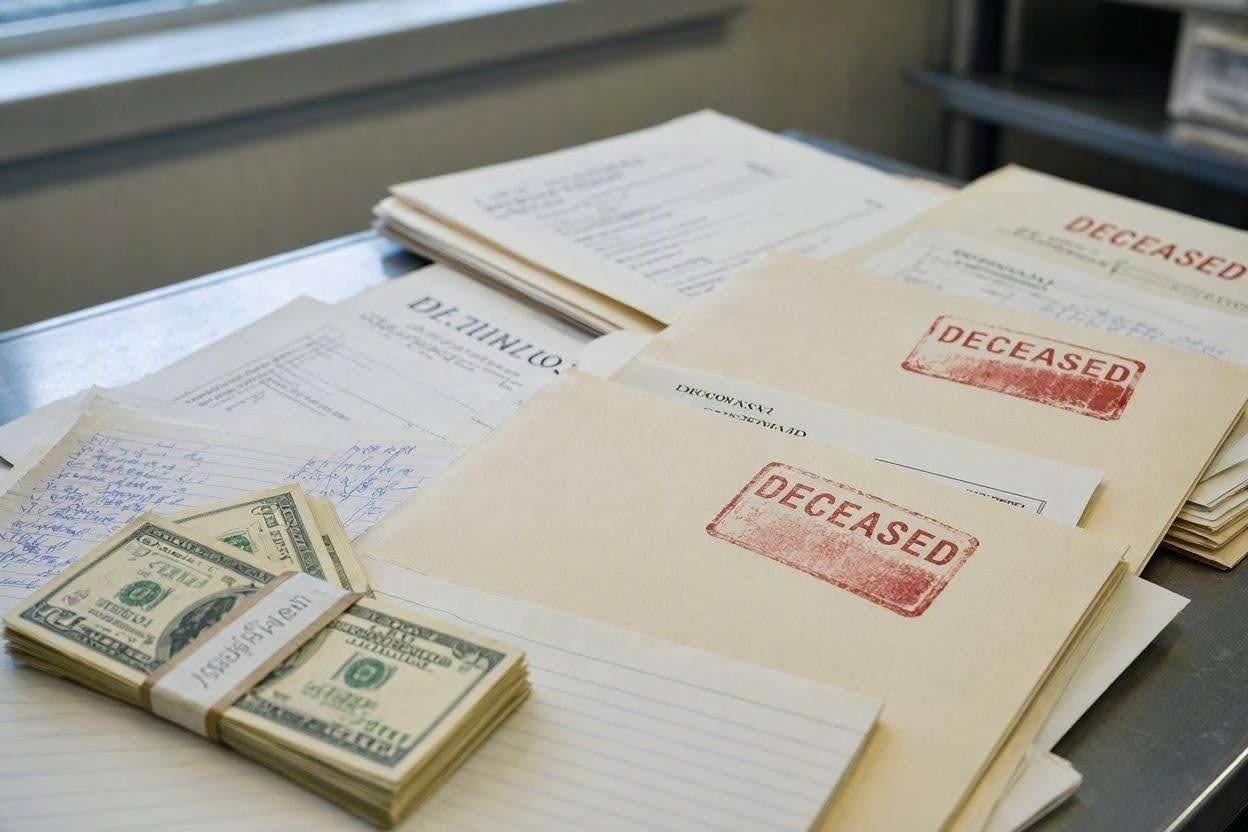

Investigators allege a Los Angeles funeral-home employee and her acquaintance sold personal information belonging to recently deceased Medicare beneficiaries, enabling backdated hospice enrollments, fabricated medical records, and claims for care purportedly delivered before death.
WASHINGTON, DC — Federal prosecutors say an alleged Southern California hospice conspiracy transformed the private identities of recently deceased people into profitable Medicare billing assets, exploiting funeral-home access, grieving relatives, clinical paperwork, and federal reimbursement systems that ordinarily support compassionate end-of-life care.
The accusations appear in a 16-count indictment charging hospice operator Oren David Shachar and alleged marketers Jeannie Choi and Abraham Shin with offenses including healthcare fraud conspiracy, aggravated identity theft, kickback violations, and other crimes connected with approximately $27,731,000 in challenged claims.
Medicare allegedly paid approximately $26,908,000 to four hospice companies associated with Shachar, although the indictment does not assign that entire amount exclusively to deceased beneficiaries and instead describes a wider scheme involving both dead people and living patients who were allegedly ineligible.
Every charge remains an allegation, all three defendants are presumed innocent unless prosecutors prove guilt beyond a reasonable doubt, and an indictment records the grand jury’s accusations rather than findings reached after adversarial testing, witness cross-examination, or a criminal trial.
A Funeral Home Became an Alleged Source of Identities
The government’s official indictment and Southern California enforcement summary describe Choi as an employee of an unnamed California-licensed funeral home with locations around Los Angeles, where prosecutors say she gained access to deceased beneficiaries’ identifying information beginning during 2025.
Contrary to broader shorthand suggesting that several mortuary workers have been publicly identified, the filed allegations specifically name Choi as the funeral-home employee and describe Shin as her acquaintance, while leaving unnamed the business and any additional people who may have handled relevant records.
Prosecutors allege that Choi and Shin transmitted information to Shachar through text messages and WhatsApp communications, sometimes including photographs of identification documents alongside precise death details, primary-care physician names, and contact information for the deceased person’s next of kin.
The indictment says the purchased identifiers included names, Social Security numbers, dates of birth, and Medicare identification numbers, a combination capable of connecting an individual to federal eligibility records while supporting the appearance of a genuine patient profile inside an electronic healthcare system.
Those allegations describe something more organized than opportunistic theft from unattended paperwork, because the claimed transactions joined privileged funeral-industry access with hospice enrollment knowledge, medical-record requests, family contacts, clinician credentials, carefully selected death circumstances, and a reimbursement channel capable of producing federal payments.
Why Recently Deceased People Allegedly Had Special Billing Value
According to prosecutors, deceased identities helped the hospices make their patient populations appear more consistent with authentic end-of-life care, because a provider enrolling numerous living people who later left hospice could generate an unusually high live-discharge rate and attract closer Medicare scrutiny.
The government also alleges that backdated deceased-patient enrollments helped offset the effects of Medicare’s annual per-patient spending limitation, giving the claimed activity a statistical and financial purpose beyond simply adding another beneficiary number to a sequence of electronically submitted reimbursement requests.
In practical terms, prosecutors contend that a person’s death could be recast as evidence supporting a fabricated hospice history, with the final outcome making it appear that the provider had correctly identified a terminal patient whose condition naturally concluded while services remained active.
That theory distinguishes the alleged conduct from ordinary post-death billing errors, delayed claim submissions, or administrative corrections, because investigators describe intentional acquisition of identifiers followed by the construction of a clinical timeline that supposedly began before the beneficiary actually died.
The indictment does not claim that every deceased person connected with the four companies was improperly enrolled, however, and prosecutors must ultimately link particular identifiers, communications, records, claims, and payments to defendants who allegedly acted knowingly and without lawful authority.
Rules Allegedly Selected the Most Usable Deaths
Shachar allegedly instructed marketers to offer only deceased individuals who had died at home rather than inside a hospital or another institution, a restriction that could reduce competing documentation and immediate oversight from facilities maintaining detailed admission, treatment, discharge, and death records.
Prosecutors further say an acceptable person had to die within five days after a marketer contacted Shachar, creating a narrow interval in which recently gathered information, the recorded time of death, hospital records, and family outreach could be assembled into an allegedly plausible pre-death sequence.
The proposed beneficiary also could not have been receiving hospice services from another provider when death occurred, according to the indictment, because overlapping enrollment records would present an obvious contradiction and potentially trigger questions from Medicare contractors, clinicians, relatives, or the legitimate provider.
Shachar allegedly insisted that the funeral home maintain exact records of each person’s date and time of death, information prosecutors say enabled his side to prepare corresponding records and arrange meetings where surviving relatives could sign hospice paperwork after the death.
Taken together, those alleged rules suggest a screening system designed around documentary compatibility, since dying at home, lacking another hospice provider, and entering the network within five days could make invented services harder to disprove through readily available third-party records.
From Stolen Data to Backdated Medical Records
Once Shachar determined that a deceased person had been enrolled in Medicare and might have qualified for hospice coverage while alive, prosecutors say he, a nurse, or Choi contacted surviving relatives by telephone or met them at the funeral home.
Those contacts allegedly gathered personal health information that could supply symptoms, diagnoses, recent treatment, and family context, while employees at Shachar’s offices separately requested records from the deceased beneficiary’s recent hospital visits to deepen the appearance of a legitimate clinical file.
Prosecutors say Shachar then directed a nurse, a physician identified only by a number, and other participants to create false electronic records stating that a nurse had evaluated the person while alive and that a physician had certified a terminal prognosis.
The records were allegedly backdated, an especially important accusation because Medicare hospice coverage generally requires contemporaneous certification that a patient’s life expectancy is six months or less if the illness follows its normal course, together with a signed election choosing comfort-focused care.
If proven, the claimed workflow would show how genuine facts can be rearranged into a false transaction without inventing every detail, because an authentic identity, real hospital history, an actual family member, a valid Medicare number, and an accurate death time can surround fabricated encounters and certifications.
This mixture of authentic and allegedly fabricated information can be difficult for automated systems to identify immediately, particularly when each individual field appears structurally valid and the more revealing contradiction lies in chronology, provenance, author access, or whether a clinical encounter occurred.
Payments Allegedly Rewarded Access to the Dead
The indictment says Shachar paid Choi and Shin at least $1,000 and up to $3,000 for each deceased beneficiary referral ultimately enrolled, compensation substantially higher than the approximately $700 monthly payment prosecutors say marketers sometimes received for each living beneficiary billed to Medicare.
That price difference, if proven, would reflect the alleged commercial value of a death that could improve a hospice’s statistical profile, limit the period requiring invented care, and provide a fixed endpoint around which backdated records and billing dates might be arranged.
Separate counts accuse Shachar of offering and paying $300 to Choi for a living beneficiary referral during September 2025 and another $300 to Shin for a January 2026 referral, illustrating that prosecutors distinguish particular kickback transactions from broader allegations about purchased deceased identities.
The indictment also alleges that Shachar sold nine Medicare beneficiary identification numbers to an unnamed physician for $12,500 during March 2025, adding a separate accusation that patient identifiers moved outward from the alleged network as commodities rather than remaining confined to hospice admissions.
An Amicus International Consulting examination of illegal identity-change methods that can lead to arrest explains why appropriating a deceased person’s identifiers differs fundamentally from a lawful name change, because authorization and record continuity determine whether identity use is legitimate or criminal.
Families Were Allegedly Drawn into the Paper Trail
The government’s account places grieving relatives in a uniquely vulnerable position, because they allegedly encountered hospice representatives during funeral arrangements or received telephone requests for medical information after a death, when administrative demands can feel routine and urgent rather than suspicious.
Relatives may have recognized every biographical and medical detail placed before them, yet recognition would not necessarily reveal that prosecutors later believed the purported admission date, nursing encounter, physician certification, or services were invented and positioned before the recorded time of death.
The indictment does not publicly identify those relatives, explain what each person was told, or establish that every signature was obtained through the same method, leaving those circumstances to be developed through evidence while protecting families from unnecessary public exposure.
Their testimony could nevertheless become central, since prosecutors may rely upon family accounts to establish when contact occurred, which documents were presented, whether hospice care was ever discussed before death, and whether anyone actually visited or treated the beneficiary while alive.
Defense counsel could examine the same encounters for ambiguity, authorization, imperfect recollection, or employee misconduct outside a defendant’s knowledge, demonstrating why emotionally powerful allegations still require individualized proof concerning each record, communication, payment, and person accused of participating.
Four Hospices Formed the Alleged Billing Network
The indictment collectively labels Gentle Touch Hospice Care in Valley Glen, Oxford Hospice Care in Montclair, Art of Hospice in Encino, and Holly Trinity Hospice in Glendale as the Shachar Hospices, although each retained its own corporate identity and operating history.
Corporate and Medicare records cited by prosecutors place Shachar’s alleged ownership or control of Art of Hospice as early as October 2019, Oxford during December 2020, Gentle Touch during February 2021, and Holly Trinity during April 2023.
Those dates should not be confused with the charged conspiracy period, which prosecutors say began no later than February 2021 and continued through at least March 2026, while Choi and Shin allegedly joined during different portions of 2025.
Shachar allegedly submitted at least 11 Medicare enrollment applications certifying that claims would represent medically necessary services actually provided and would comply with federal rules prohibiting kickbacks, false statements, deliberate ignorance, and reckless disregard for whether billing information was truthful.
Connecting four providers through common control may help prosecutors explain repeated methods and money movement, but the government must still show which company submitted each charged claim, which defendant caused it, and why the underlying representation was knowingly false.
The Financial Scale Extends Beyond Deceased Patients
Across the alleged conspiracy, the four hospices submitted approximately $27,731,000 for services prosecutors characterize as unnecessary, reimbursement-ineligible, misrepresented, or obtained through illegal inducements, and Medicare allegedly paid approximately $26,908,000 on those challenged claims before the operation ended.
Those aggregate figures cover more than deceased identities, because the indictment also alleges that living beneficiaries who were not terminally ill received as much as $400 monthly, groceries, alcohol, televisions, massages, furniture, medical equipment, and other benefits for remaining enrolled.
Some living beneficiaries were allegedly offered another $100 or $200 for referring additional people, while marketers could receive recurring payments tied to the months a person remained billable, creating incentives that prosecutors say converted hospice admissions into a layered recruitment marketplace.
The government alleges that $15,000 left a Holly Trinity Hospice bank account during September 2024 as part of a lease-to-own down payment for a Rolls-Royce Phantom, forming the basis of a count involving a transaction in allegedly criminally derived property.
Contemporary reporting from FOX 11 Los Angeles placed the hospice case within a nationwide enforcement operation involving $6,500,000,000 in alleged false claims, while noting that the identities of affected deceased beneficiaries and the extent of funeral-industry involvement remained undisclosed.
Why Hospice Claims Depend on Trustworthy Identity Data
Medicare’s hospice benefit is intended for people whose physicians certify a terminal illness, generally meaning life expectancy of six months or less if the disease follows its normal course, and whose signed election selects palliative services instead of certain curative treatment.
Covered care can include nursing, pain and symptom medication, equipment, social services, therapy, dietary counseling, and spiritual support, making the program both clinically complex and deeply personal for patients whose families are navigating serious illness and approaching death.
Claims ordinarily identify the beneficiary, Medicare number, service type, service date, and attending provider, while continued coverage beyond two initial 90-day periods requires recurring certification and, at specified stages, an in-person evaluation supporting ongoing terminal eligibility.
Each electronic submission therefore relies on multiple trust relationships, including confidence that an identifier belongs to the represented patient, that a clinician performed the documented work, that the chronology is authentic, that the election was informed, and that no prohibited payment purchased the referral.
When accurate identifiers are allegedly combined with invented encounters, those relationships can fail without obvious formatting errors, because Medicare may receive a technically complete claim whose deception becomes visible only after communications, audit trails, death records, and financial transfers are compared.
Identity Theft Does Not End When a Person Dies
Death may close many personal accounts, but it does not immediately erase a person’s Social Security number, insurance history, medical relationships, family contacts, or administrative records, leaving a valuable identity footprint across institutions that update their systems at different speeds.
Criminal misuse can therefore continue after a victim can no longer notice an unfamiliar statement, question a new provider, dispute a clinical entry, or alert relatives, shifting detection responsibility toward families, institutions, data matching, investigators, and professionals guarding sensitive records.
The Shachar indictment illustrates an especially troubling variation because the alleged objective was not to impersonate a living consumer seeking credit, but to manufacture a short healthcare history that ended at a real death and generated public reimbursement through trusted providers.
Amicus International Consulting’s guidance on lawful pathways for creating a legally recognized identity emphasizes traceable authorization, legitimate government procedures, and consistent records, principles that stand opposite to secretly transferring identifiers or fabricating another person’s medical history.
For funeral businesses, hospices, hospitals, and insurers, the case underscores why access controls must align with job responsibilities, downloads and message transfers require monitoring, family disclosures need clear explanations, and unusual post-death record activity should prompt review rather than routine processing.
The Charges Require More Than a Disturbing Narrative
Count one charges all three defendants with conspiracy to commit healthcare fraud, counts two through nine identify particular alleged executions of healthcare fraud, and counts ten through twelve allege aggravated identity theft involving three deceased beneficiaries identified publicly only through initials.
Count thirteen concerns the $15,000 vehicle-related transfer, counts fourteen and fifteen allege kickback payments for referrals, and count sixteen accuses Shachar of selling nine Medicare identifiers, creating distinct elements and proof requirements that cannot be satisfied merely by establishing an overarching relationship.
Prosecutors may use messages, device records, access logs, patient charts, death certificates, claim histories, bank transfers, enrollment applications, corporate filings, clinician testimony, and family accounts to argue that recurring details demonstrate deliberate coordination rather than negligence or isolated administrative mistakes.
Defense lawyers may challenge authorship, context, medical eligibility, employee authority, the reliability of cooperating witnesses, the meaning of payments, and whether any defendant knew information belonged to deceased people when particular records or claims moved through complex office systems.
Aggravated identity theft presents an especially consequential issue because conviction generally depends upon proof that a defendant knowingly used another actual person’s means of identification without lawful authority during a qualifying felony, not simply that inaccurate data appeared somewhere inside a provider file.
A National Crackdown with an Individual Burden of Proof
The case was announced during the 2026 National Health Care Fraud Takedown, which federal officials described as involving 455 defendants, including 90 licensed medical professionals, across 56 judicial districts and alleged schemes totaling more than $6,500,000,000 in intended fraudulent claims.
Authorities also announced more than $182,000,000 in seizures, administrative payment suspensions affecting 1,079 providers, and billing-privilege revocations involving 1,403 providers, showing how financial and regulatory consequences can begin while criminal accusations remain unresolved in court.
National statistics provide enforcement context but cannot establish individual guilt, and prosecutors must prove the charged conduct against Shachar, Choi, and Shin separately through admissible evidence rather than relying upon the scale, rhetoric, or unrelated cases included within the broader takedown.
The Federal Bureau of Investigation and the Department of Health and Human Services Office of Inspector General are investigating, while Justice Department Trial Attorney Michael Bacharach is prosecuting the case through the federal healthcare fraud enforcement structure in Los Angeles.
Shachar and Shin were arrested on June 18, 2026, made initial appearances, and were released on bond, while Choi was arrested several days later, according to the Justice Department announcement that originally listed an August trial date subject to ordinary scheduling changes.
What the Allegations Mean for Healthcare Data Security
The alleged scheme exposes a boundary problem spanning several industries, because funeral homes collect death information, hospitals preserve treatment histories, physicians hold certification authority, hospices submit claims, and Medicare pays when records assembled across those organizations appear credible and complete.
No single control can eliminate that risk, yet institutions can restrict access by role, flag bulk or unusual record views, block unauthorized messaging applications, reconcile service dates against death registries, verify family authorization, and investigate hospice admissions created unusually close to death.
Auditors can also examine whether a provider’s live-discharge rate, length-of-service distribution, referral concentration, recruiter compensation, late-created clinical notes, and place-of-death patterns differ sharply from comparable hospices, especially when several companies appear connected through ownership or shared personnel.
Families reviewing Medicare notices can report services they do not recognize, although the deceased-patient scenario demonstrates why consumer vigilance alone is insufficient, since relatives may never receive timely statements and may reasonably assume that post-death medical correspondence reflects routine claim completion.
Stronger protection therefore requires coordinated verification rather than indiscriminate surveillance, preserving legitimate access for compassionate care and funeral administration while creating durable records showing who viewed, exported, transmitted, changed, certified, or billed against each sensitive identity.
A Case About Public Money, Private Grief, and Due Process
Hospice fraud allegations carry unusual human weight because they concern a benefit designed to protect dignity near death, and misuse can distort medical histories, interfere with informed treatment choices, exploit family grief, and weaken confidence in legitimate providers serving vulnerable patients.
The allegation that deceased identities were purchased makes the case especially stark, yet responsible reporting must resist converting vivid details into verdicts before witnesses testify, electronic evidence is authenticated, medical opinions are examined, and each defendant receives the constitutional protections of criminal procedure.
If prosecutors prove their account, the case would demonstrate how insiders with ordinary access can convert accurate personal data into false healthcare narratives when referral payments, weak cross-system verification, and trusted electronic claims align around a profitable billing opportunity.
If the government cannot prove knowledge, authorization failures, fabricated encounters, or the connection between particular claims and particular defendants, the severity of the narrative cannot replace the legal burden that applies to every count and every accused person.
For now, the indictment stands as a detailed federal allegation that recently deceased Medicare beneficiaries became raw material for backdated hospice admissions, while the coming proceedings will determine whether prosecutors can transform that allegation into proof beyond a reasonable doubt.
















Be First to Comment