


By Clint Sanchez
The person who shows up to paint a house is often the person who owns the business. Federal labor data puts nearly a third of construction painters in the self-employed column.
Census counts of painting companies point the same way. Most firms with a payroll have only a few people on it, and a large share of the trade has no payroll at all.
A Trade Where Many Work for Themselves
The Bureau of Labor Statistics tracks the occupation under the title Painters, Construction and Maintenance. Its Occupational Outlook Handbook counts 326,900 jobs in 2025.
Of those jobs, 42% are with painting and wall covering contractors. Another 31% are held by self-employed workers. By our arithmetic, that is roughly 100,000 people working for themselves, though the shares are rounded.
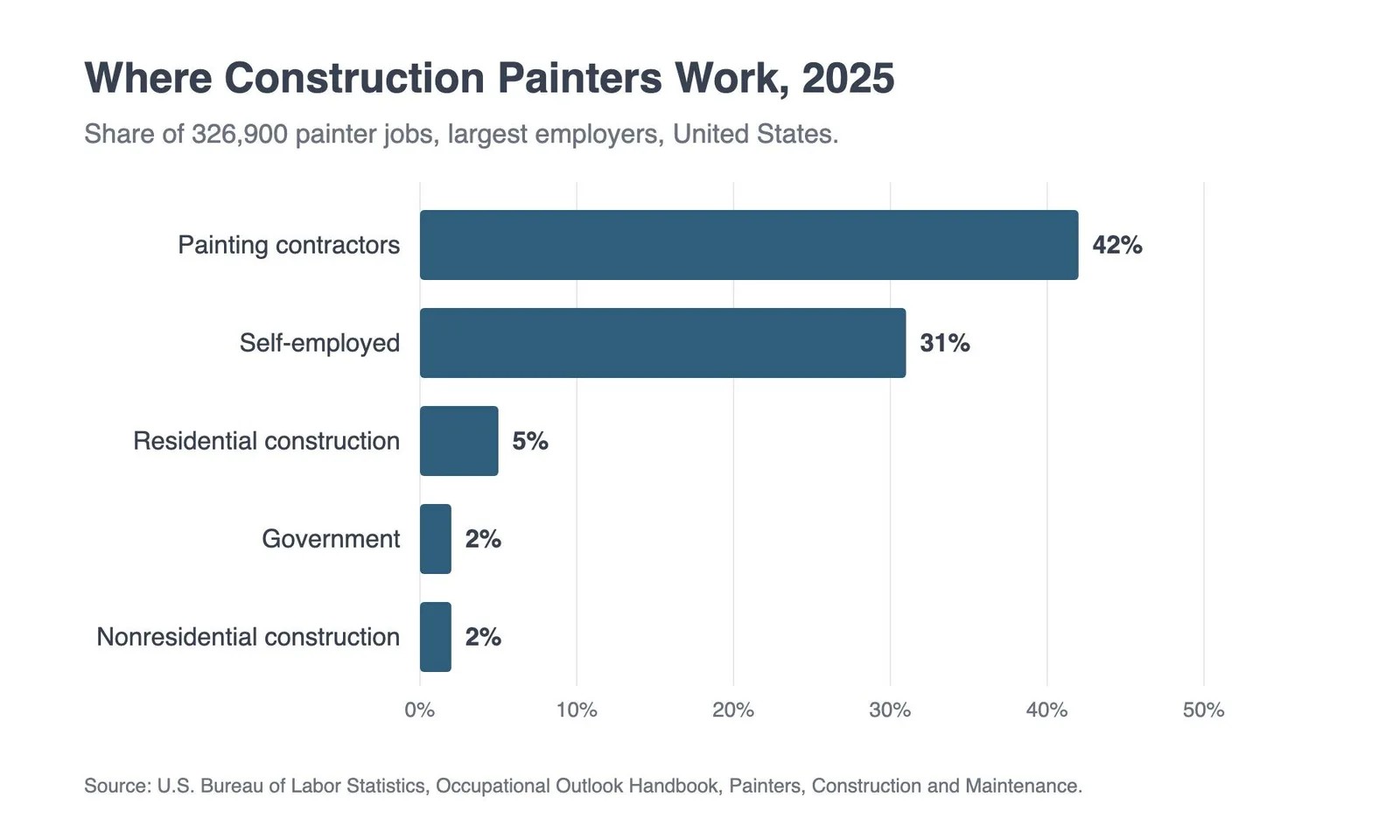
Where construction and maintenance painters work, 2025.
The rest are spread thin. Residential building construction accounts for 5%, while government and nonresidential building construction account for 2% each.
The handbook also notes that self-employed painters may be able to set their own schedules. That flexibility comes with a cost. The same person handles the estimate, the prep, the brushwork and the paperwork.
Low Barriers to Entry
Part of the reason so many painters work solo is that the door into the trade is open. The handbook lists no formal educational credential as the typical entry requirement, with moderate-term on-the-job training.
It says painters typically learn the trade on the job. The median annual wage was $49,400 in May 2025, or $23.75 an hour.
Low barriers make it possible to start small. They also mean a homeowner looking at a list of painters is usually comparing small outfits, not large firms.
Most Painting Companies Are Small
The Census Bureau’s County Business Patterns counts establishments that have paid employees, sorted by industry and size. Its latest national release covers 2023.
The industry the government calls Painting and Wall Covering Contractors had 38,280 establishments that year. Of those, 28,745 had fewer than five employees, or about three in four by our arithmetic.
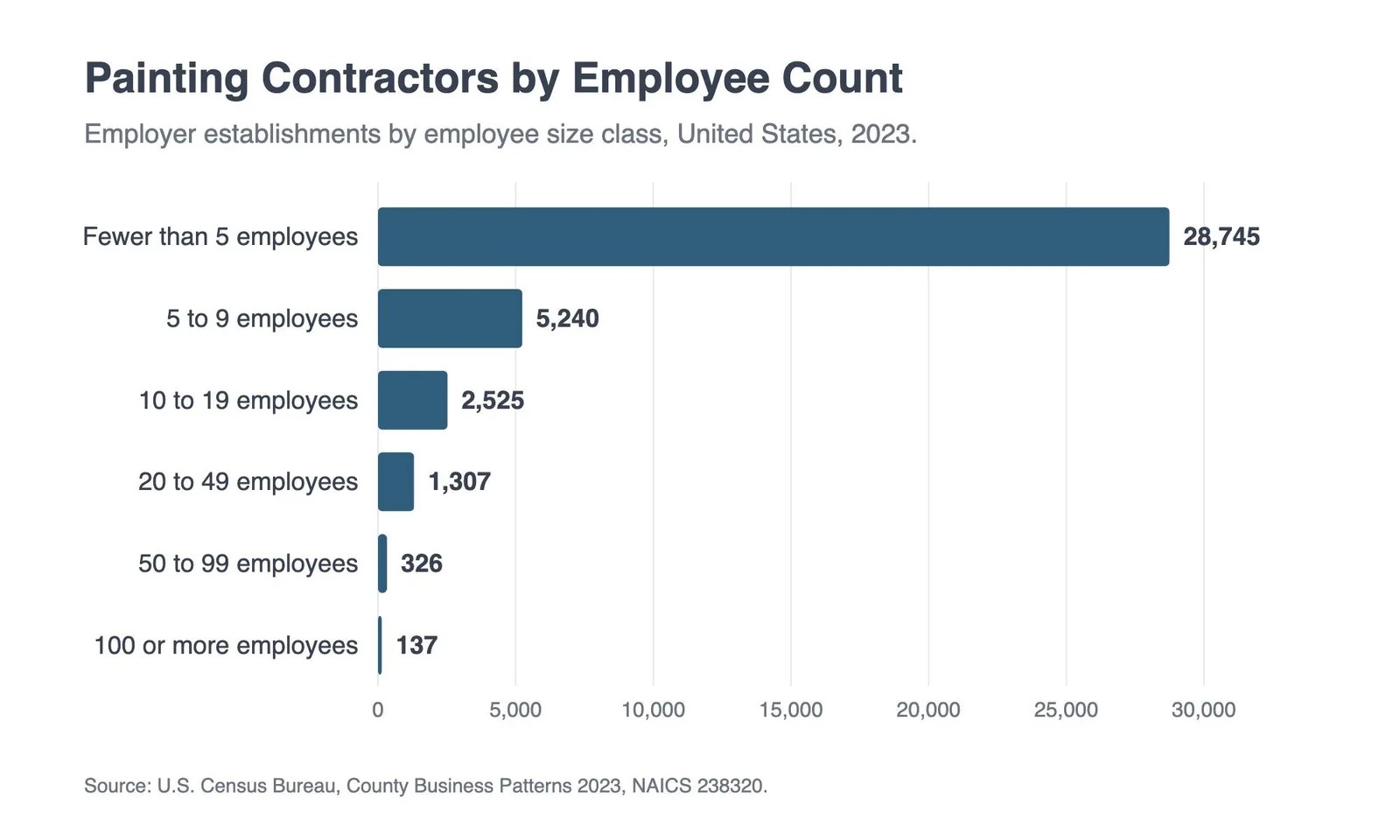
Painting contractor establishments by employee count, 2023.
Nearly nine in 10 had fewer than 10 employees, and about 95% had fewer than 20. Only 137 establishments, well under 1%, had 100 or more.
The file counts 208,201 employees across the industry, which works out to about five per establishment. Census withholds one size class for this industry, so the 137 figure is the total minus every class below 100.
One caution applies. The industry code covers wall covering contractors as well as painters, so the counts include both kinds of work.
The Businesses Without a Payroll
County Business Patterns leaves out businesses with no paid employees. The Census Bureau counts those in a separate series, Nonemployer Statistics, which covers businesses with no payroll that are subject to federal income tax.
That series does not break painting out on its own. It groups painters with drywall, flooring, tile and finish carpentry under building finishing contractors.
For that wider group, the 2023 count was 669,136 businesses with no employees, rising to 678,091 in 2024. The same group had 128,009 employer establishments in 2023. By our arithmetic, owner-only operations outnumber employers by more than five to one across the finishing trades.
The two series are separate counts with different rules, so they should not be added together as one total. Read side by side, they still show a group of trades where working alone is common.
Steady Demand, Mostly From Turnover
The handbook projects employment of painters to grow 3% from 2025 to 2035, about as fast as the average for all occupations. That adds 9,800 jobs over the decade.
Openings are a larger number. The agency projects about 24,900 a year, mostly to replace painters who change occupations or leave the labor force. Growth alone accounts for fewer than 1,000 a year by our arithmetic.
The handbook adds that outdoor painting jobs may be seasonal. For a small shop, that means exterior work can arrive in bunches, with quieter stretches in between. A slow month is when an owner has time to fix how the business shows up online.
What Small Size Means for Being Found
A painter who is also the estimator and the bookkeeper has little time left for marketing. That makes the basics matter more than anything elaborate.
Google’s help pages say local results are mainly based on relevance, distance and popularity, and that there is no way to pay for a better local ranking. A business cannot move closer to every customer. It can work on relevance and on how it is seen by people who have hired it.
For a small painting company, a few steps cover most of it:
A complete Business Profile. Google says businesses with complete and accurate information are more likely to show up in local results. Categories, service area and hours should match the work.
One page per type of job. Interior repaints, exterior repaints, cabinet refinishing and deck staining are different searches. A single services page lists them but answers none of them well.
Pages for the towns actually served. A crew that works in four towns but names only one on its website gives searchers in the other three little to match.
Photos that load quickly. Finished-job photos are often a painter’s best proof of quality, but a gallery that loads slowly on a phone works against it.
Replies to reviews. Google’s guidance says replying to reviews shows a business values the feedback.
Owners who want to see how those pieces fit together can read a breakdown of SEO for painting contractors, which walks through pages built around each job type and each town a crew works in.
A Trade Built on Small Operators
The federal numbers line up. Nearly a third of painters work for themselves, three in four employer shops have fewer than five people, and about 25,000 openings appear each year.
For homeowners, that means the next painter on the list is most likely a small business. For the owners of those businesses, the listing, the website and the reviews often decide who gets the call.

















Be First to Comment