
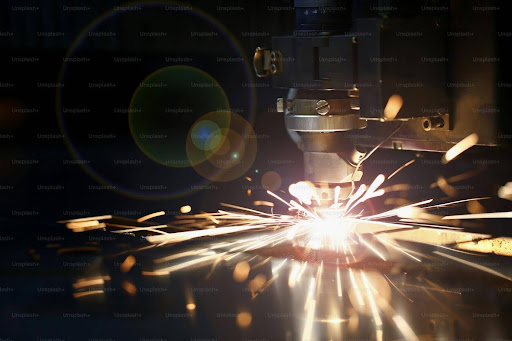

Modern manufacturing thrives where physics meets craftsmanship, and precision laser cutting is a perfect example. Advanced science directs concentrated light with micron-level control, while skilled operators guide, interpret and optimize every cut. What was once a futuristic idea has become a standard tool in high-accuracy production, enabling fabricators to shape aerospace turbines, medical stents and microelectronics with unmatched precision.
This article examines the underlying science and operational strategies that experienced engineers and fabricators use to maintain accuracy in real-world production environments.
How Laser Cutting Works: The Science Behind the Beam
Laser cutting, including flat sheet laser cutting, as explained by the certified electricians at Winward Electric, uses a highly focused beam of light to melt, burn or vaporize material along a defined path. The word “laser” refers to the process of light amplification through stimulated emission of radiation. Practically, this means a beam that is intense, narrow,and highly controllable.
The laser is focused through a lens to a very small spot, dramatically increasing its power density (intensity). When that energy meets the material, it rapidly heats the surface until it separates cleanly. Assist gases such as oxygen or nitrogen are often used to blow molten material away and improve edge quality.
Different laser types are suited to different tasks. CO₂ lasers are commonly used for non-metals and thicker materials. Fiber lasers excel at cutting metals at high speed and with high efficiency. Precision is achieved through deliberate control of wavelength, focal position, power stability and motion coordination.
The Art of Accuracy: Mastering Tolerances and Kerf
Accuracy and repeatability solve different problems. Accuracy answers whether the machine can reach a target X–Y location. Repeatability answers whether it can return to that same location hundreds or thousands of times without drifting. In production environments, repeatability is often more important. A repeatable system can be compensated. An unstable one cannot.
Challenges in Ultra-High Precision
Modern high-end laser systems routinely repeat to within a few ten-thousandths of an inch, but holding part tolerances closer than ±0.001 inches introduces challenges beyond the laser source itself.
The biggest challenge is heat. As sheets heat during cutting, they expand. If parts are cut from a localized hot area, they can shrink out of tolerance once the material cools. Experienced metal fabrication shops manage this through cut order and nesting strategy. Rather than cutting adjacent parts back-to-back, heat is distributed across the sheet to keep expansion predictable.
Beam stability is another common challenge. Dirty optics or a degraded cover glass can cause subtle focus drift, widening the kerf mid-run. External vibration from nearby equipment can also appear as fine-edge chatter, especially at high acceleration.
Managing Kerf Width
Kerf width must be treated as a process variable rather than a fixed value. It changes with speed, focus, direction of travel and heat buildup. Tight-tolerance features require intentional kerf compensation in the toolpath. Smaller, consistent kerf widths also enable tighter nesting, reducing scrap in high-volume production.
Optimizing Cut Quality: Metallurgy and Edge Finish
Dimensional accuracy means little if edge quality is poor. Slag, rough striations or heavy oxidation typically indicate process imbalance rather than machine limits. Material composition plays a significant role. Mild steel, stainless steel, aluminum and specialty alloys all react differently to the same energy input.
- Dross buildup on the bottom edge typically indicates excessive heat input and slow cutting speeds.
- Rough or striated edges often result from excessive gas pressure or mechanical vibration disrupting melt flow.
- Incomplete cuts mainly result from insufficient energy delivery.
Corners require special attention. As the cutting head slows to change direction, energy dwell time increases. Without compensation, this leads to burned or rounded corners. Power ramping, where output is reduced as speed drops, is one of the most effective ways to maintain edge quality on tight geometries.
Material Compatibility
Reflective metals remain a challenge. Copper and brass can reflect energy toward the optics if the pierce strategy, focus or surface condition is poorly controlled.
Modern fiber lasers mitigate this risk through back-reflection monitoring and optical isolation, but process discipline is still required. According to the certified metal fabricators at Richard’s Sheet Metal, settings that work on steel rarely translate directly to highly reflective materials.
Safety
Here are two important safety precautions for precision laser cutting:
- Fiber laser wavelengths pass through the cornea and can damage the retina instantly, making fully enclosed, interlocked cutting systems mandatory. Proper wavelength-rated eye protection is required during setup and maintenance.
- Cutting generates fine metal particles and hazardous fumes, particularly when processing stainless or coated materials. Effective extraction protects operators and prevents contaminants from settling on optics.
Final Thoughts
Machine specifications don’t solely determine the precision of laser cutting. It is defined by how well physics, motion, material behavior and operator judgment are controlled together.
The laser provides capability, but experience determines consistency. For fabricators working at tight tolerances, precision is not a setting; it’s a discipline built on understanding where accuracy is gained and where it’s lost.